How do I track which K-1s I am still waiting on?
It depends on how many partnerships you hold and who needs the files. With a handful, a status board works: one row per issuer and tax year, marked expected, received, or late. If you want reminders and accountant access across many K-1s, an intake product such as K-1 Collector is built for that. If you are a firm or fund producing or extracting K-1 data at scale, K1x is built for that. If you want each K-1 filed next to the investment, keep it in Raziel.
K-1 alternative investments tracking is intake, not filing. Before anyone maps boxes to a 1040, you need a status board: which issuer still owes a Schedule K-1, for which tax year, and whether it is expected, received, or late. Private-fund, real-estate partnership, and SPV packages trickle in on other people’s calendars. A column per partnership is more useful in February than a folder of unlabeled PDFs. This is how to track K-1s so the packet is complete when your accountant asks, not another walkthrough of how to report the numbers.
What a K-1 is (and what this page is not)
The IRS 2025 Instructions for Form 1065 call it an information return. A partnership generally does not pay tax; it passes profits and losses through to partners. Schedule K-1 (Form 1065) reports each partner’s share. The 2025 Partner’s Instructions say keep the form for your records and do not file it with your return unless you are specifically required to. The partnership files a copy with the IRS. You can still owe tax on your share whether or not cash was distributed.
How those boxes land on a return (basis, QSBS, Schedule D, amended Form 1040-X) is Raziel’s startup investment tax reporting guide. This page stops at the inbox. If the PDF is missing, late, or only the federal face page, the reporting guide cannot help yet.
Issuer, tax year, expected / received / late
Open one row per partnership interest, per tax year. Do not merge years, and do not treat two vehicles that share a brand as one issuer.
Issuer. Legal name and EIN from Part I of the K-1, plus the vehicle you hold (direct LLC, fund, or SPV) and the person or portal you chase. As of October 2026, K-1 Collector’s homepage is built around this list: add investments first, documents later, across funds, partnerships, and LLCs, and across tax years.
Tax year. The year printed at the top of Form 1065 and of each Schedule K-1 or K-3. The 2025 Form 1065 instructions say to fill that space for a fiscal or short year. If you file a calendar-year 1040 and the partnership year ends in February 2026, the Partner’s Instructions say you report those amounts on your 2026 return. Log the partnership year, not the week the PDF arrived.
Status. Expected, received, or late. As of October 2026, K-1 Collector uses Upcoming, Pending, Received, and Overdue, and invites the accountant onto the same board. Received means a file you can hand over. If an amended K-1 replaces an original, keep both and mark which is current.
Dates you can defend
IRS 2025 Form 1065 instructions: a domestic partnership generally files by the 15th day of the third month after year-end: March 15 for calendar-year partnerships. For the 2025 partnership year, March 15, 2026 was a Sunday, so the instructions treat a March 16, 2026 filing as timely. File Form 7004 by the regular due date for an automatic extension. For each failure to furnish Schedule K-1 (and Schedule K-3, if applicable) when due, a $340 penalty may apply per schedule, as of the IRS 2025 Form 1065 instructions.
Raziel’s tax-reporting guide notes the operational consequence: K-1s can legally arrive as late as March 15, or September 15 with extensions. Put a date in Expected. If the GP filed Form 7004, expected is that extended partnership date, not your April 15. Late is the day after expected with no PDF. Log the last chase: date, channel, who you asked.
State footnotes, K-3, and the rest of the package
A received flag on a two-page federal K-1 is not a complete package. The Partner’s Instructions: an asterisk after a code means an attached statement; STMT in the dollar column means the item is not a single number. Those attachments (footnotes, white papers, state allocations) are what the accountant needs. As of October 2026, K1x’s K1 Aggregator page says face-page tools miss footnotes, whitepapers, state, and international detail, and it markets native K-3 handling plus state K-1 data for what it calls all 42 state taxing jurisdictions. Treat those as vendor claims. Log whether state pages and a K-3 are present.
Schedule K-3 extends Schedule K-1 for international items. The IRS 2025 K-2/K-3 instructions say partners include that information on their returns if it applies. If the fund has foreign activity and no K-3 arrived, the row is not done. Same for a state K-1 that travels as a second PDF. Name files issuer + tax year + federal / state / K-3 / footnotes.
A status board is not tax software
Two products own this search, and they are not interchangeable. K-1 Collector sells intake: arrived vs. late, accountant access, reminders, bulk download. List prices as of October 2026: Investor $99/year (up to 10 investments), Pro $399/year (up to 100), Enterprise $999/year (up to 250), with a 180-day trial. K1x sells the private-market tax-data lifecycle (Aggregator to receive and extract, Creator to produce, including footnotes and digital .k1x packages) to firms, family offices, funds, and administrators. As of October 2026, its homepage claims 44 of the top 100 institutional investors, 20 of the top 25 accounting firms, and 40,000+ organizations. First-party marketing, not a ranking, and not Raziel’s.
A workbook can hold issuer, year, and status. The columns are on Raziel’s K-1 tracker template. It fails when one name issues an original, an amended, a state set, and a K-3 into four inboxes.
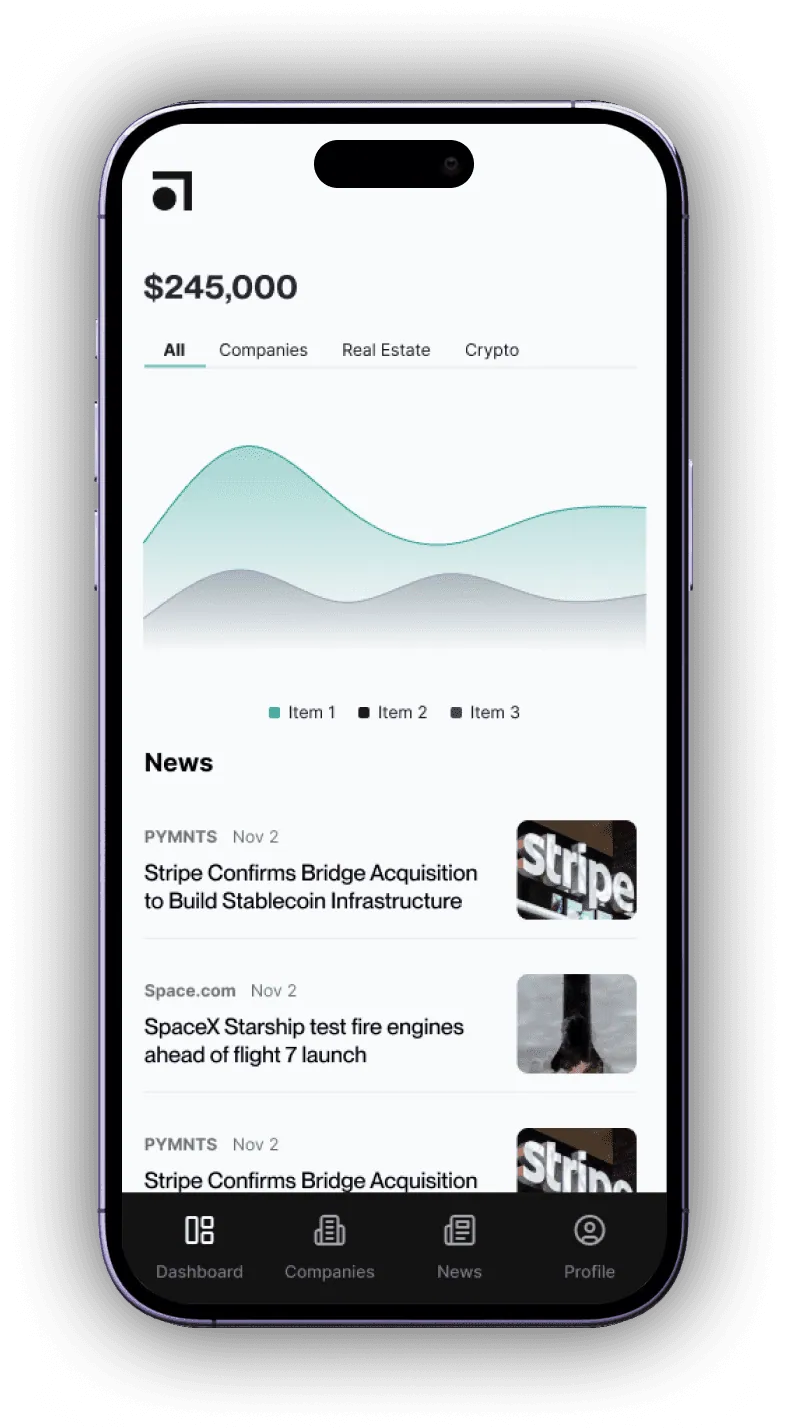
Raziel’s alternative-asset dashboard is the investment record those files should sit on: startups and public equities, with AI document ingest (as of October 2026). Real estate and crypto tracking are coming soon. Raziel does not prepare returns and does not give tax advice. Park the K-1 on the same commitment as the capital calls and the cash dates. When the accountant asks, send a status column and a complete packet. Create a free account or see Raziel for startup investors.
This is not legal, tax, or investment advice. Raziel, Inc. does not provide it.