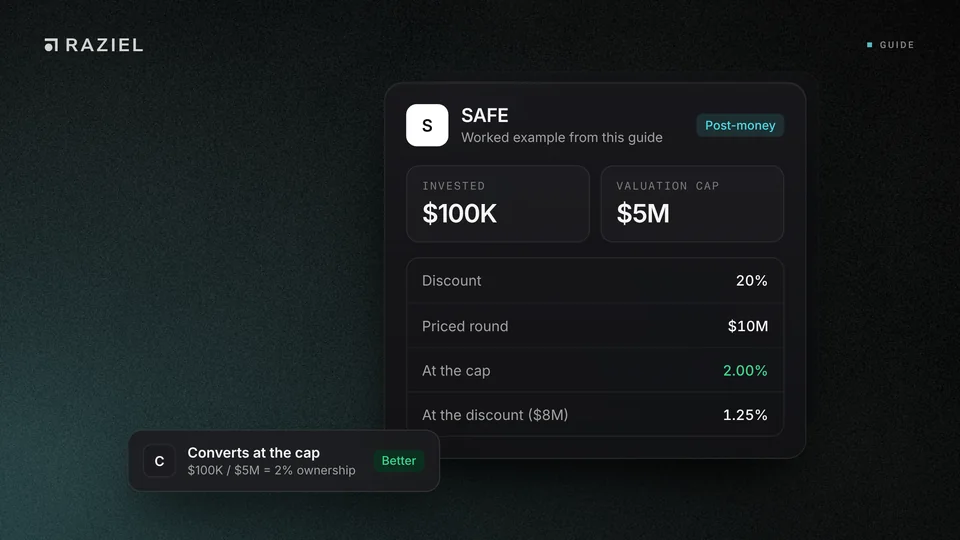
Does my SAFE convert at the valuation cap or the discount?
Log the conversion at the better of the two prices: at conversion, the investor gets whichever term gives the more favorable price. A $100K SAFE with a $5M cap and a 20% discount in a $10M round converts at the cap for 2% ($100K / $5M), not 1.25% at the discounted $8M. That napkin reads like a post-money SAFE. A pre-money SAFE moves with every later SAFE and the option pool increase, so log which form you signed. Record the cap, discount, and form the day you wire on SAFE note tracking. Our free SAFE conversion calculator shows the shares and ownership a SAFE converts into.
A SAFE's cap and discount decide one number: the valuation your check converts at when the priced round closes. The investor gets the better of the two, so a $100K SAFE with a $5M cap and a 20% discount in a $10M round converts at the cap for 2% ($100K / $5M), not 1.25% at the discounted $8M ($100K / $8M).
The full math is below, along with what to track after you wire.
What Is a SAFE Note?
SAFE stands for "Simple Agreement for Future Equity." It is a flexible investment instrument introduced by Y Combinator that allows investors to fund a startup now in exchange for equity at a future priced round.
Unlike traditional convertible notes, SAFEs do not accrue interest or have a maturity date. Instead, they convert into equity when the startup raises a priced round, based on pre-negotiated terms.
Key SAFE Terms: Valuation Cap and Discount
Valuation Cap
This is the maximum valuation at which your SAFE will convert into equity, regardless of the valuation of the next priced round.
Example: If the priced round is at a $10M valuation but your SAFE cap is $5M, your investment converts as if the valuation were $5M, giving you more equity.
Discount
This gives the investor a percentage discount on the valuation at which the SAFE converts, typically between 10% and 25%.
Example: If the priced round is at $8M and your SAFE includes a 20% discount, your investment converts as if the valuation were $6.4M.
Both Terms Present
Most SAFEs include both a cap and a discount. At conversion, the investor gets the more favorable term.
Why These Terms Matter
Ownership Impact: Lower caps mean more equity for the same check size.
Investor Protection: Caps and discounts reward early risk by ensuring better pricing.
Signal of Market Power: Negotiated caps reflect founder leverage and investor competition.
Future Dilution: SAFEs dilute founders and existing holders at the priced round, when they convert into shares.
Questions Investors Should Ask
What valuation cap are you offering, and how was it determined?
Is there a discount, and what is the conversion trigger?
How much capital are you raising on this SAFE?
Are there multiple SAFEs with different terms?
How will the cap impact ownership if the priced round happens at X valuation?
These questions help uncover potential dilution and clarify investor alignment.
Conversion Math in Action
Let’s say you invest $100K in a SAFE with:
Valuation cap: $5M
Discount: 20%
Priced round: $10M
You get the better of:
$5M cap = 2% equity ($100K / $5M)
20% discount = $100K / $8M = 1.25% equity
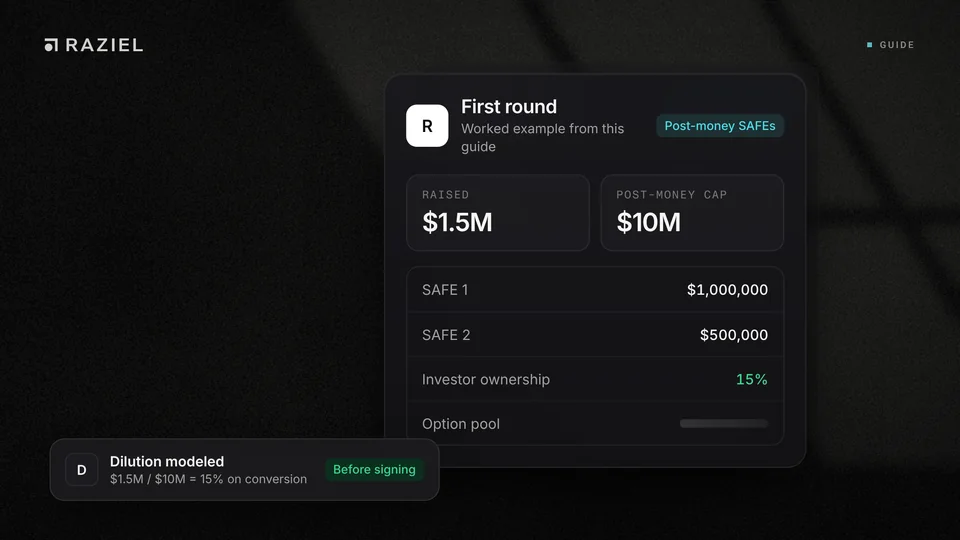
In this case, your SAFE converts at the cap for more favorable equity. This napkin divides the check by the cap, which is how a post-money SAFE reads. A pre-money SAFE moves with every later SAFE and the option pool increase, so log which form you signed (post-money vs pre-money SAFE).
After you wire: what to track on the SAFE
Caps and discounts matter twice: the day you sign, and the day the priced round closes. In between, the SAFE is a row in your book, not shares.
Log the cap, the discount, any MFN, and whether the form is post-money or pre-money the day you wire (SAFE note tracking).
If the company also sold convertible notes, keep interest and maturity on their own rows (convertible note vs SAFE).
When the priced round closes, close the SAFE and open the preferred shares on the same cash history. A conversion is not a second wire (how to track SAFE conversions at a priced round).
Stack every SAFE and note before you model the round (how angels should read a cap table).
Know What You Are Signing Up For
Before you sign, run the cap and the discount against the round price you expect and note which one wins. After the round closes, check the shares you received against that math.
Raziel keeps each SAFE in the same book as your priced rounds and direct checks, with the documents, the cap table, and IRR next to it (as of October 2026). Create a free account or see Raziel for startup investors.
This is not legal, tax, or investment advice. Raziel, Inc. does not provide it.