Should I sign a convertible note or a SAFE?
Start with what the round is already using, then weigh the one structural difference. A convertible note is debt: it accrues interest, which converts into extra shares, and it has a maturity date that forces a conversation if no round shows up. A SAFE has neither, so the amount that converts is the check you wired. Both commonly carry a valuation cap, a discount, or both. Whichever you sign, log the terms on a dated row: SAFE note tracking for a SAFE, convertible note tracking for a note.
Convertible note vs SAFE: the short answer
The convertible note vs SAFE question comes down to one line: a convertible note is debt and a SAFE is not. Y Combinator's SAFE FAQ puts it plainly: a convertible note accrues interest and carries a maturity date set for repayment or forced conversion. A SAFE has neither. Both let an angel invest before a priced round, both are built to convert into equity when that round closes, and both commonly carry a valuation cap, a discount, or both.
Founders often prefer SAFEs because there is no interest clock and no maturity date to manage. Angels sometimes prefer notes for the extra structure: interest that adds to the amount that converts, and a maturity date that forces a conversation if no round shows up. Each structure carries a different risk and reward trade-off, so read the document you are signing, not the label on it.
How the terms differ
Interest. A note accrues interest. Cooley's Series Seed note form converts the outstanding principal plus any unpaid accrued interest in a qualified financing, so the interest becomes extra shares. A SAFE has no interest, so the amount that converts is the check you wired.
Maturity. A note has a maturity date when repayment or conversion comes due. A SAFE has no maturity date and stays open until a priced round or another event named in the document.
Cap and discount. Either instrument can set a valuation cap, a discount to the next round price, or both. The conversion section of your document says which price applies. Do not assume.
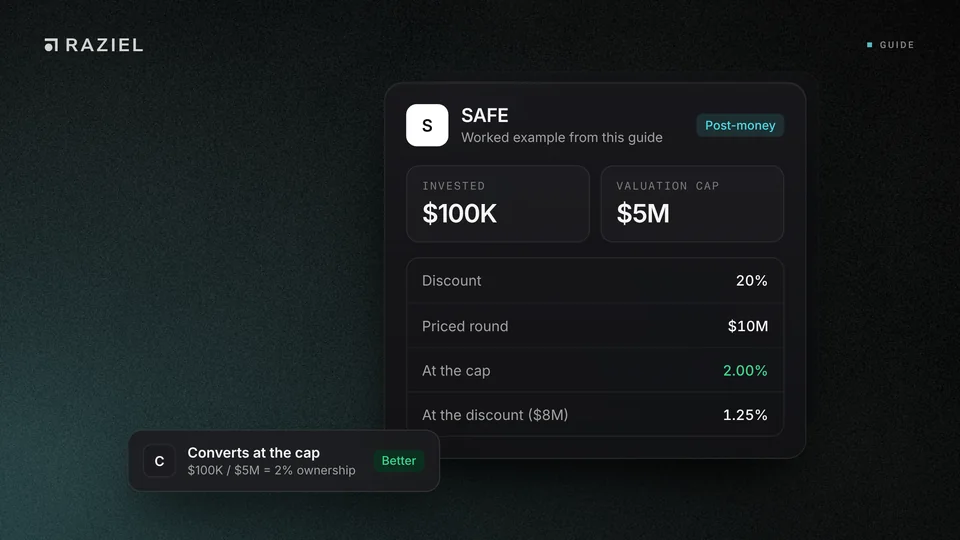
Post-money vs pre-money. SAFEs come in two forms. On YC's post-money SAFE, your implied ownership at the cap is the Purchase Amount divided by the Post-Money Valuation Cap. Pre-money SAFEs stacked in the same raise dilute each other, so the same napkin math overstates what you own.
Paperwork. A SAFE is usually a short standard form. A note is a promissory note with more terms to negotiate and more fields to log.
Which one should an angel sign?
Usually the one the round is already using. The choice depends on your risk tolerance, the terms on offer, and the protections you want. If you have leverage, ask four questions: is the cap realistic against the next round, is there a discount, is there an MFN clause or a pro rata side letter, and, for a note, what happens at maturity if there is no qualified financing. Whatever you sign, the work after the wire is the same: put the terms on a dated row so the conversion math is not a reconstruction two years later.
What to track after you wire
The wire is the start of the record, not the end. Log the cash date and amount once, then the terms that decide what the check turns into.
SAFE terms. Log the cap, the discount, MFN yes or no, and any pro rata side letter. SAFE note tracking walks through the full row.
Note terms. Log principal, interest rate, the date interest starts, and the maturity date. Convertible note tracking covers the interest and maturity fields.
SAFE form. Record whether each SAFE is post-money or pre-money, because the form changes how your ownership moves when more SAFEs stack up. See post-money vs pre-money SAFE tracking.
Conversion. When the priced round closes, close the SAFE or note row and open the preferred position from the conversion notice (series, share count, price) while keeping the original wire date. SAFE conversion tracking shows what happens at the priced round.
Stock clock. If the lot started as a SAFE or note, the QSBS clock may start on the conversion issuance date, not the wire date (talk to your tax advisor about how your instrument is treated). Log that date on the QSBS holding period tracker, which keeps stock acquired on or before July 4, 2025 in a separate bucket from stock acquired after July 4, 2025.
Track both on one book
Raziel keeps SAFEs, notes, and the preferred stock they convert into on the same book, with documents, cap tables, IRR and MOIC, and AI document import. Raziel does not issue shares and does not give legal or tax advice. Create a free account to log your first SAFE or note, or see Raziel for startup investors.
This is not legal, tax, or investment advice. Raziel, Inc. does not provide it.