Your first round is the one with the least data and the most decisions. You are choosing how much to raise, what instrument to use, what price to accept and who to let onto your cap table, usually while still building the product. This guide walks through the whole process for a pre-seed or seed round, from deciding whether to raise at all to the first investor update after the money lands.
I have been on both sides of the table as a founder and as an investor in 40+ startups. The founders who raise well are rarely the ones with the flashiest deck. They are the ones who know their numbers, run a tight process and treat investors like a long-term relationship rather than a one-time transaction.
1. Decide whether venture capital is right for you
Venture capital is built for companies that can grow very large, very fast. Investors expect most of their portfolio to fail and need a few companies to return the whole fund, so they back businesses with a credible path to a large outcome. If your business could be a healthy, profitable company at a smaller scale, revenue, a bank loan, revenue-based financing or a small friends-and-family round may serve you better and cost you less ownership.
Raise venture money when outside capital lets you move meaningfully faster toward a big market, and you are comfortable with the expectations that come with it: growth targets, regular reporting and, eventually, an exit.
2. Work out how much to raise
Start from milestones, not from a number that sounds impressive. Ask what you need to prove before your next round (a launched product, paying customers, a revenue run rate, retention data) and what it costs to get there.
- List the milestones that would make the next round easy to raise.
- Build a simple monthly budget for hiring, product, marketing and overhead until you hit them.
- Add a buffer. Most founders aim for roughly 18 to 24 months of runway, because fundraising takes longer than planned and plans change.
Our free runway calculator shows how many months a given raise buys you at your burn rate. Raising too little forces you back into fundraising before you have results; raising too much at an early valuation means giving up more of the company than you need to.
3. Choose the instrument: SAFE, convertible note or priced round
Most first rounds in the US use one of three structures.
SAFE (Simple Agreement for Future Equity)
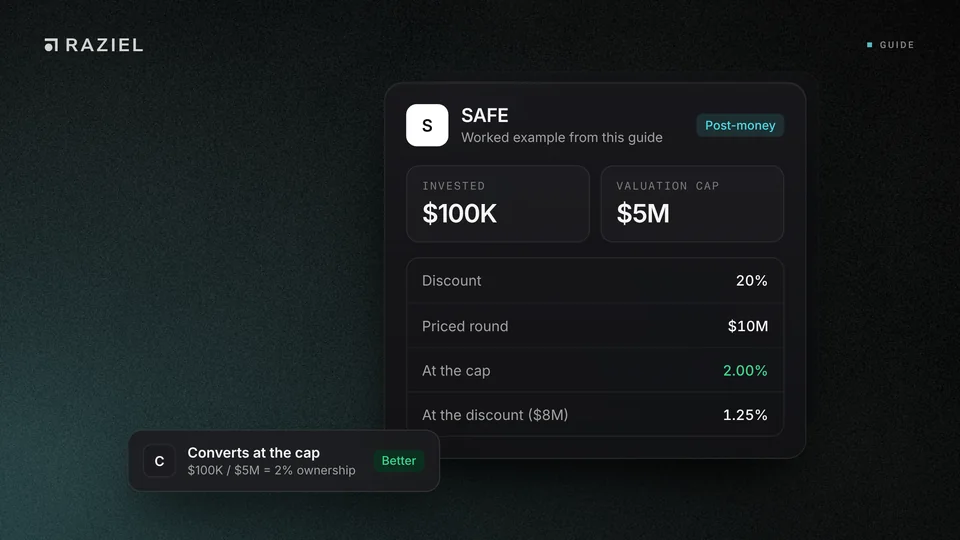
Introduced by Y Combinator, the SAFE is the most common pre-seed instrument. The investor gives you money now and receives shares later, usually when you raise a priced round. It is not debt: there is no interest and no maturity date. The key terms are the valuation cap (the maximum valuation at which the money converts), an optional discount to the next round's price, and sometimes a most favored nation (MFN) clause. Today's standard is the post-money SAFE. See SAFE valuation caps and discounts explained for the details.
Convertible note
A convertible note is short-term debt that converts into equity at the next priced round. Like a SAFE it usually has a cap and a discount, but it also carries an interest rate and a maturity date, which can create pressure if you have not raised again by then. Compare the two in convertible notes vs SAFEs, and model one with the convertible note calculator.
Priced equity round
In a priced round you sell preferred shares at an agreed price per share. It takes more legal work and usually a lead investor who sets the terms, often including a board seat. Many seed rounds and nearly all Series A rounds are priced.
For a first round with several small checks, SAFEs are usually the fastest and cheapest option. If one investor is writing most of the check and wants a priced round, follow their lead and get a good startup lawyer.
4. Understand valuation and dilution before you talk to investors
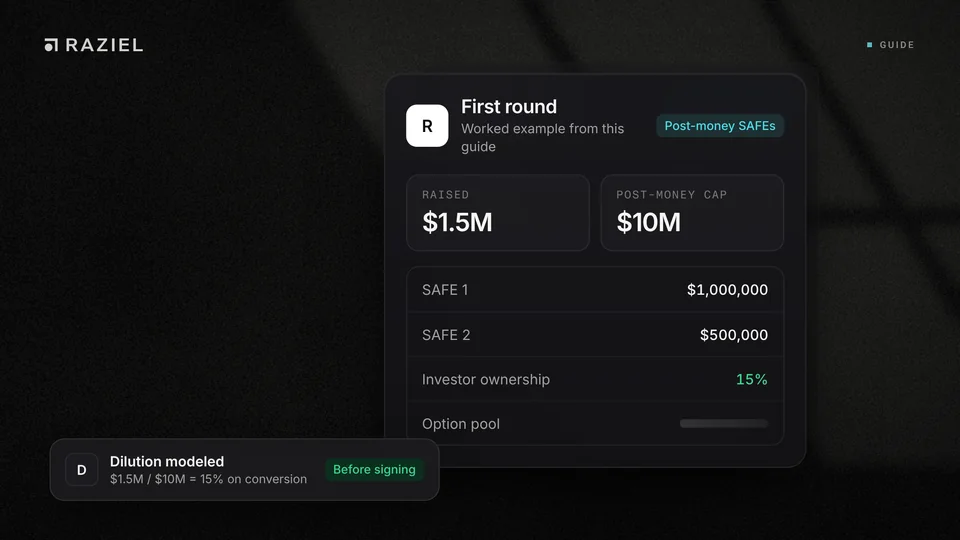
With a post-money SAFE, the math is simple: the investor's ownership is their investment divided by the post-money valuation cap.
| Scenario | Amount | Post-money cap | Ownership on conversion |
|---|---|---|---|
| One SAFE | $1,000,000 | $10,000,000 | 10% |
| Second SAFE, same cap | $500,000 | $10,000,000 | 5% |
| Both together | $1,500,000 | $10,000,000 | 15% |
Because each post-money SAFE fixes the holder's percentage, every additional SAFE dilutes the founders, not the earlier SAFE holders. Stacking several SAFEs at different caps is the most common way founders end up owning less than they expected at the Series A. Two more things reduce your stake when the SAFEs convert:
- The new round itself. New investors buy their own percentage, which dilutes everyone, including the converted SAFE holders.
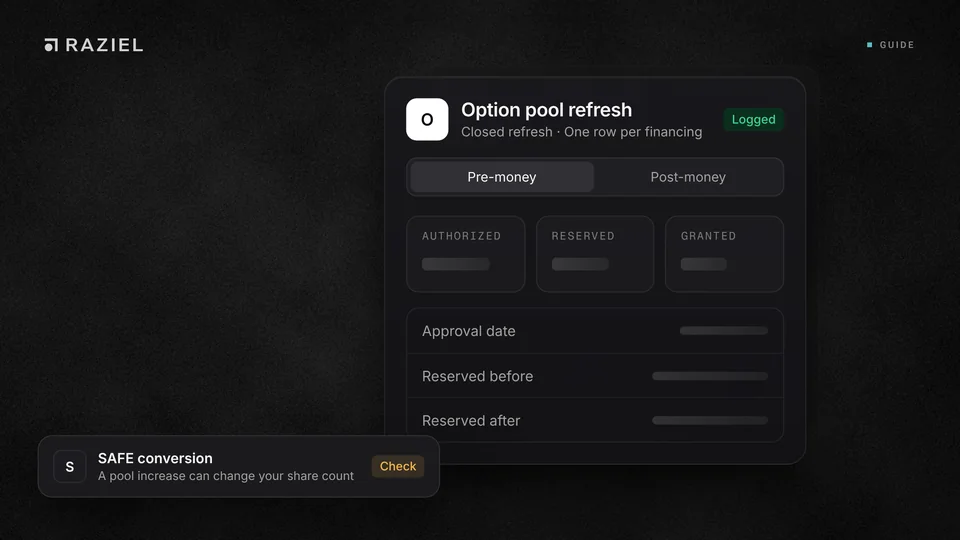
- The option pool. Investors often ask for an employee option pool to be created or topped up before the round, which comes out of the existing holders.
Run your own numbers with the SAFE conversion calculator, the dilution calculator and the option pool calculator. If you want a starting point for valuation, the startup valuation calculator walks through common early-stage methods. Know your fully diluted ownership after the round before you sign anything.
5. Build a targeted investor list
Fundraising is a funnel. You will talk to many more investors than will invest, so build a list of the right ones rather than emailing everyone.
- Stage: only pre-seed and seed investors. A growth fund will not lead your first round.
- Check size: make sure their typical check fits your round.
- Sector and thesis: look at their portfolio and what they write about. Skip investors who back your direct competitors.
- Lead or follow: know who can set terms and lead, and who prefers to join once a round has a lead.
- Who you know: angels, operators in your industry, accelerators, pre-seed funds and syndicates. Warm introductions from founders they have backed are far stronger than cold email.
Track every investor, intro, meeting and next step in one place. A spreadsheet works for ten names; past that, an investor CRM keeps you from dropping follow-ups when the process gets busy.
6. Make a clear pitch deck
Your deck should let a busy investor understand the business in a few minutes. Ten to twelve slides is plenty for a first round:
- Company in one line: what you do and for whom.
- Problem: who has it and how painful it is.
- Solution: your product and why it works.
- Why now: what changed that makes this possible or urgent today.
- Market: who buys and how big it can get, built bottom-up where you can.
- Product: screenshots or a short demo.
- Traction: users, revenue, growth, pilots, waitlist. Real numbers, clearly labeled.
- Business model: how you make money.
- Competition: the alternatives, including spreadsheets and doing nothing, and why you win.
- Team: why you are the people to build this.
- The ask: how much you are raising, the instrument, and the milestones it funds.
Send a short, readable version ahead of meetings and keep a fuller version for the meeting itself. Every number in the deck should hold up when an investor asks how you got it.
7. Run a tight process
Momentum matters more than almost anything else in a raise. Investors move faster when they see others moving.
- Prepare everything first: deck, financial model, target list, cap table and the answers to the questions you know are coming.
- Batch your first meetings into a few weeks instead of spreading them over months, so interest builds at the same time.
- Start with investors lower on your list to sharpen the pitch, then meet your top choices.
- Follow up within a day of every meeting with what you promised and a clear next step.
- Find your first committed check. A lead or a respected first investor makes everyone else's decision easier.
- Send short progress updates to interested investors during the raise. New customers or a key hire are reasons to re-engage.
8. Get ready for due diligence
Early-stage diligence is light, but a messy company slows a close. Keep these organized in a data room before you start:
- Certificate of incorporation, bylaws and board consents
- A clean, current cap table, including every SAFE and note
- Founder stock purchase agreements, vesting and IP assignment agreements
- Key customer and vendor contracts
- Basic financials and your model
9. Close the round
When investors commit, move quickly to signed documents and wired funds. Confirm the final terms in writing, use standard documents where you can, and have a lawyer review anything non-standard, including side letters for pro rata rights or information rights. After the first sale of securities in a Regulation D offering, a Form D is due to the SEC within 15 days, and some states require their own notice filings, so ask your lawyer to handle them. Then update your cap table so it reflects every investor and instrument.
10. Start investor updates the month after you close
Your relationship with investors starts when the money arrives. A short monthly update with your key metrics, wins, challenges and specific asks keeps them engaged and makes your next raise far easier, because your best future investors are often your current ones. Our investor update template guide shows what to include, and the pro rata calculator helps you plan for existing investors who want to follow on.
What changes when you raise a Series A
A Series A is usually a priced round led by an institutional fund, and the bar moves from potential to evidence. Investors look for a repeatable way to acquire customers, clear product-market fit and a plan to scale. Expect deeper diligence, a board seat for the lead and more negotiation over terms like liquidation preferences and the option pool. Every SAFE and note from your first round converts at this point, so model the full conversion before you agree to a price.
Keep your fundraise organized with Raziel
Raziel is a free workspace for founders: track investors and intros in an investor CRM, keep your cap table and SAFEs in one place, and send investor updates that show you who opened them. The Founder plan is free for up to 100 contacts. See Raziel for founders.
FAQ
How long does it take to raise a first round?
It varies widely. Plan for at least a few months from preparation to money in the bank, and start before you are low on cash.
Should I raise on a SAFE or a priced round?
For a pre-seed round made up of several smaller checks, a post-money SAFE is usually faster and cheaper. If a single lead investor is putting in most of the money and asks for a priced round, a priced seed round is common.
How much of my company should I sell in my first round?
There is no fixed rule. Founders generally try to keep total dilution in an early round modest so there is room for later rounds and an option pool. Model your ownership through the Series A with the dilution calculator before you agree to a cap.
Do I need a lead investor?
For a priced round, yes, because someone has to set the price and terms. For a SAFE round, not strictly, but a respected first check builds momentum and makes it easier for others to commit.
What should I send investors after the round closes?
A monthly or quarterly update with metrics, progress, challenges and asks. See the investor update template guide.