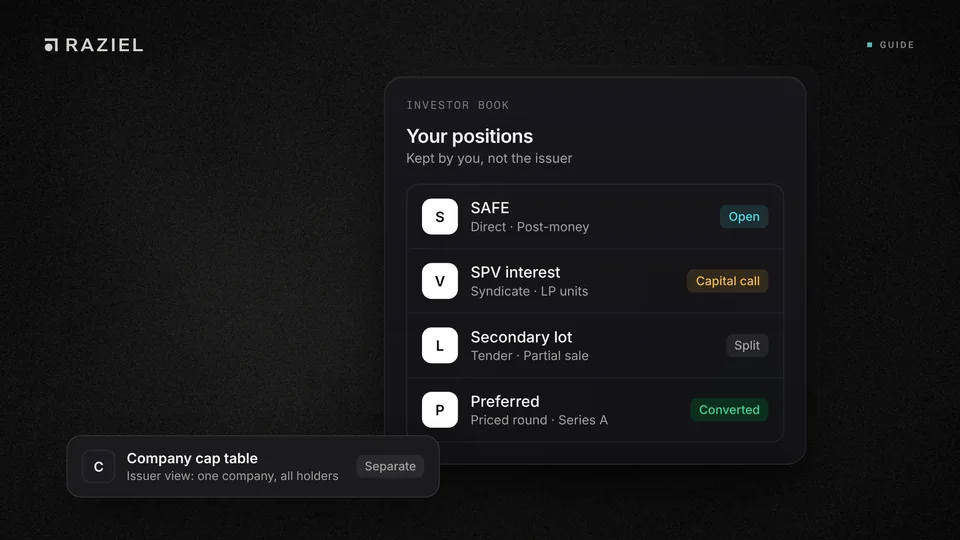
Most private investors start with a spreadsheet: one row per investment, columns for amounts and dates, and a few formulas for returns. It is flexible, familiar and usually free. It also gets harder to maintain with every new check, capital call and statement. This guide shows how to move your portfolio from Excel or Google Sheets to Raziel, and when a spreadsheet is still the right tool.
Who this guide is for
- Angels and syndicate leads with more than a handful of startup positions, SAFEs and SPV interests.
- Family offices tracking fund commitments, capital calls and holdings across several entities, often in a workbook several people edit.
Why investors move off spreadsheets
Spreadsheets are a reasonable place to start. As of October 2026, Google Sheets is free with a Google account, Excel is free on the web and mobile, and desktop Excel comes with Microsoft 365 Personal at $99.99/year (Microsoft 365 plans). Excel's XIRR function handles irregular cash flows well.
The friction shows up as the portfolio grows:
- Everything is typed by hand. Every round, capital call and distribution is read from a PDF and retyped.
- Marks go stale. A cell holds the value you last entered until you remember to change it.
- Formulas drift. You build and audit every XIRR and multiple yourself, and a copied range can break them quietly.
- Sharing is all or nothing. Access to the file is access to every number in it.
Family offices feel this most. When several people edit one workbook, it becomes hard to tell which version is current, who changed a mark, or whether last quarter's capital call was entered twice. Statements arrive by email, get saved to a folder, and wait for someone to type them in. Raziel is built to take that retyping off your plate: forward a statement and its AI records the details against the right holding, so the record stays current between quarterly reviews.
What moves and what does not
| In your spreadsheet | In Raziel |
|---|---|
| Startup rows: SAFEs, notes, priced rounds, secondaries | Positions in the Portfolio Dashboard, re-marked when a new round is recorded |
| Fund and SPV tabs with calls and distributions | Commitments, capital called, NAV and distributions per vehicle |
| Return formulas | MOIC, IRR, TVPI and DPI from your cash flows in Valuations & Returns |
| Tabs per LLC or trust | Entities & Vehicles |
| Statements in a folder | Documents attached to each holding through AI Document Import |
| Public equities, real estate, crypto | Coming soon. Keep these in your spreadsheet for now. |
| Custom models and scenarios | Keep them in your spreadsheet. |
See Raziel vs spreadsheets for the full comparison.
Step by step: moving your portfolio
- Clean up the file. Give each investment its own row with company or fund name, entity, instrument, date, amount invested and, for SAFEs, cap and discount. Put capital calls and distributions on their own dated rows. Our angel portfolio spreadsheet template lists the columns worth having.
- Start a 14-day Investor trial. Sign up and create a workspace. Family offices can keep separate workspaces for each family branch or a syndicate.
- Create your entities. Add each LLC, trust and personal account before importing so holdings land under the right owner.
- Import your spreadsheet. Spreadsheet import is one of Raziel's integrations. Bring your existing positions over in one pass.
- Check every holding. Compare totals against your file. Confirm amounts and dates, and add anything that did not come across.
- Attach the paperwork. Forward or upload SAFEs, purchase agreements and capital account statements. The AI pulls out the amount, cap, discount and dates and files each one with the right company or vehicle. AI is optional, and you can add positions by hand instead.
- Connect your bank accounts. Connect accounts so cash sits next to your investments.
- Record new rounds once. When a company raises, enter the new price per share and Raziel re-marks every position in that company and updates your returns.
- Invite the people you used to email the file to. Add a spouse, partner or accountant as an owner, editor or viewer through Workspaces & Permissions. Every user signs in with multi-factor authentication.
What to keep in your spreadsheet
Keep any custom model only you need to read, such as exit scenarios or allocation plans. Keep public equities, real estate and crypto there until those asset classes arrive in Raziel. And keep an archive copy of the original workbook. Many investors find that the spreadsheet becomes a scratch pad while Raziel becomes the record.
FAQ
Can I import my existing spreadsheet?
Yes. Spreadsheet import is built in, so you can bring existing positions over and keep them current from there.
How does Raziel's IRR compare with Excel's XIRR?
Like XIRR, Raziel uses the dates and amounts of your actual cash flows, so irregular capital calls and distributions are handled. You do not have to build, copy or audit the formulas. To check a figure, try the free XIRR calculator or TVPI and DPI calculator.
Is a spreadsheet still fine for a few positions?
Yes. For a handful of positions that rarely change, a spreadsheet works well. Raziel saves the most time once you hold several startups, SPVs or funds and receive regular statements. Our roundup of angel investment trackers compares both approaches.
Is my data secure?
Every Raziel user signs in with mandatory multi-factor authentication, and documents open only through links that expire after 15 minutes. Raziel's SOC 2 Type II and ISO 27001 work is in progress.
What does it cost?
The Investor plan has a 14-day free trial, then $49/month through 30 companies and $199/month above that.
Get started
Bring your spreadsheet over once and stop retyping statements. Start your free Raziel trial and see every position, entity and return in one place.